


Portable ACs mostly differ in how they pull in and push out air. That single design choice affects cooling performance, energy use, and how hard the unit has to work.
Portable AC Guide: How to Choose and Use It Right
NOV 13, 2026
Last updated: NOV 14, 2026


2751 views, 5 mins read
Summer in Australia has a way of turning the lounge room into a sauna. If you rent, can't justify a split system, or just want one room cool, a portable air conditioner is the practical answer.

This portable air conditioner buying guide covers the decisions that actually matter — which type to pick, how to size it, what it really costs to run, and how to set it up so the unit isn't fighting itself. By the end you'll know exactly what to buy, and what to skip.

In this article
1. Different Types of Portable AC Units
2. How Do Portable Air Conditioners Work?
3. Pros and Cons of Portable AC
4. Sizing Your Portable Air Conditioner: What Capacity Do You Need?
5. Key Features to Consider Before Buying
6. Step-by-Step Portable AC Installation
7. 5 Tips to Maintain a Portable Air Conditioner for Best Performance?
8. FAQs
Different Types of Portable AC Units
1. Single-hose units
A single-hose portable AC draws warm room air in, cools it, and exhausts heat and moisture through one hose out the window. The catch: it creates negative pressure, which can pull hot outside air back in through gaps. These are usually cheaper and simpler, but less efficient in a hot room.
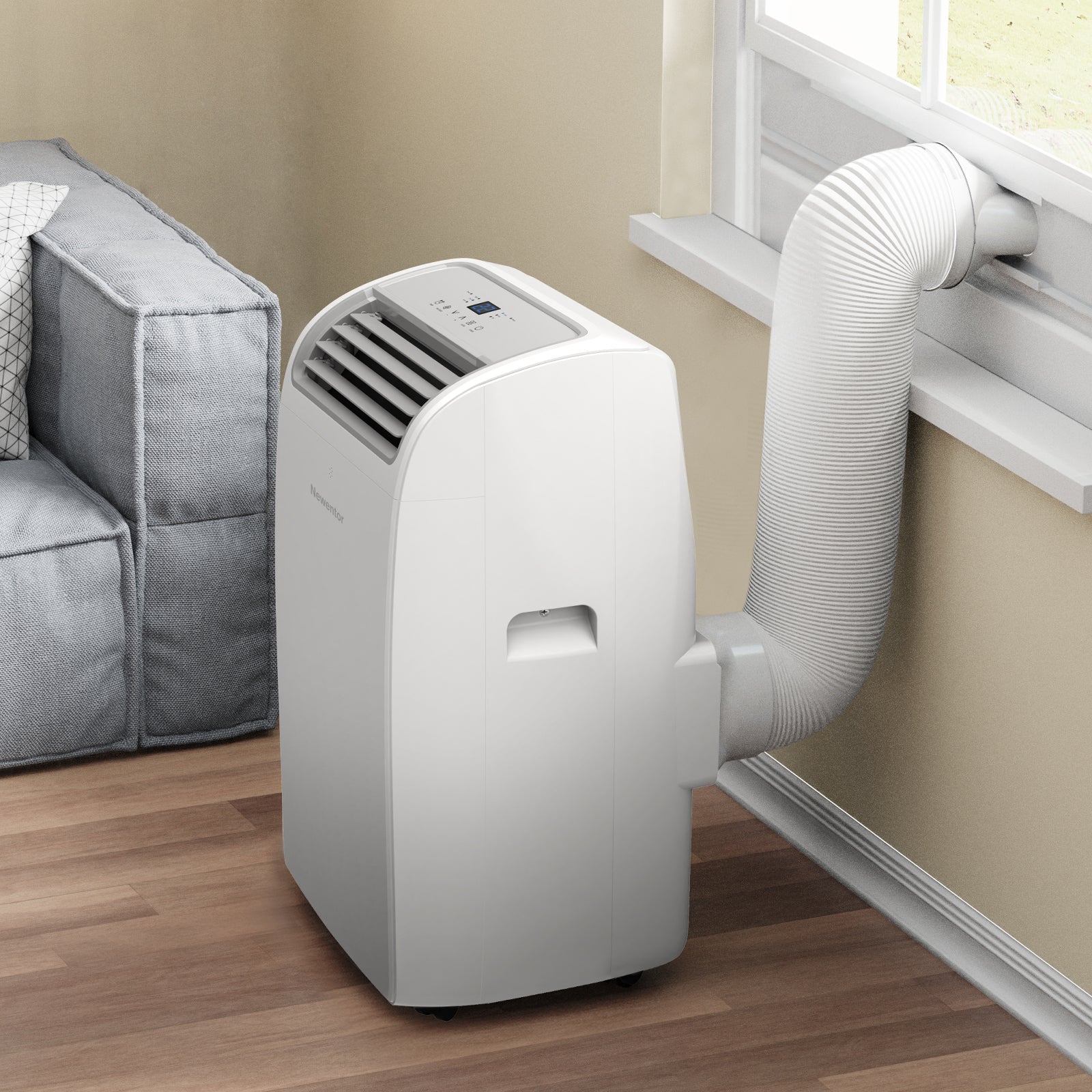
2. Dual-hose units
A dual-hose unit uses one hose to bring outside air in for the condenser, and a second hose to dump heat back out. It avoids the negative-pressure problem, so cooling holds up better in sealed rooms. Dual-hose models tend to cost more, but they’re the better pick if you’re cooling a room you actually spend time in.
3. Evaporative coolers
Evaporative coolers add moisture to the air rather than removing it. In humid Australian conditions, they can make a room feel muggy and uncomfortable. If you see “portable air cooler” at a low price, check whether it’s actually a refrigerated AC or just a fan-and-water setup.
How Do Portable Air Conditioners Work?
A portable AC works like a mini split system, just in one box. It pulls warm air over refrigerated coils, absorbs the heat, and sends cooled air back into the room.
The heat it absorbs has to go somewhere. That’s what the exhaust hose is for — it carries heat and moisture out the window. The moisture part matters: portable units pull water out of the air as they cool, and that water has to be managed.
What happens to the water
Most modern units use auto-evaporation, where condensation is recycled over the condenser and vented out with the exhaust air. Older or cheaper units may need manual draining via a tank or hose. In humid weather, even self-evaporating models may need occasional draining. Factor that into your routine before you buy.
Pros and Cons of Portable AC
Portable ACs are a convenience-first product. They’re not the most powerful cooling option, but they solve a specific problem: you can’t or won’t install a window or split system.
Pros
- No permanent installation.Roll it in, connect the hose to a window, and you’re cooling within minutes.
- Movable between rooms. Most units have castors, so you can shift cooling from the lounge to the bedroom.
- Renter-friendly. No brackets, no drilling, no landlord approval needed for a window unit.
- Easy to store. Wheel it into a closet at the end of summer.
Cons
- Louder than window AC. The compressor sits inside the room, so noise is unavoidable. Aim for a unit rated under 52 dB if you’ll sleep near it.
- Takes up floor space. You need to place it near a window, with clearance around the vents.
Sizing Your Portable Air Conditioner: What Capacity Do You Need?
BTU is the headline number, but the room size it actually cools depends on more than the label. As a starting point, GE’s sizing guide maps BTU to square footage like this:
| BTU | Room Size |
|---|---|
| 8,000 BTU | 14–23 ㎡ |
| 10,000 BTU | 20–35 ㎡ |
| 12,000 BTU | 25–43 ㎡ |
| 14,000 BTU | 43–56 ㎡ |
Then adjust: add 10% for a room that cops full afternoon sun, subtract 10% if it's heavily shaded, add 4,000 BTU for a kitchen, and add 600 BTU for every person beyond two.
One warning worth repeating: bigger isn't better. An oversized unit cools the air fast but never removes the humidity, leaving the room cold and clammy while the compressor short-cycles.
If your maths lands on 3.5 kW:
- The Newentor Portable Air Conditioner is built exactly for that bracket — 12,000 BTU (3.5 kW), rated for 25–43 m², with an SGS-certified compressor co-developed with De'Longhi and 390 m³/h of airflow that drops outlet temperature to 18°C within three minutes. It uses R290 refrigerant and runs at 44–63 dB, so it's quiet enough for a bedroom.
Key Features to Consider Before Buying
Noise level. Check the dB figure, not the marketing word "quiet". Under 50 dB suits a bedroom; anything near 63 dB will keep light sleepers awake.
Auto-evaporation. Some units pump condensate back through the exhaust so you never touch a drain plug. Others fill a tank you have to empty mid-heatwave. Ask before you buy.
A window kit that fits your window. Sliding, casement and awning windows all need different seals. A kit that fits badly is a cooling leak you paid for.
Modes. Cooling is table stakes. Fan-only and dehumidify modes mean the unit still works on mild, muggy days without burning compressor power.
Filtration. A washable mesh filter is fine. HEPA-grade filtration is a genuine bonus if you have allergies, pets, or live near a busy road.
Warranty. Most brands stop at two years, and a handful reach three. That tells you something about confidence in the compressor. Newentor covers theirs for ten years with a 30-day replacement window — a fairly unusual offer in this category.
Step-by-Step Portable AC Installation
No tools, no tradie, about ten minutes.
- Pick the spot. Put the unit near a window, on a flat surface, with about 30 cm clearance around the air intake and outlet.
- Connect the hose. Screw one end into the exhaust port, then run the other end out the window. Keep it as short and straight as you can — every bend costs cooling.
- Seal the window. Slide the kit panel into place and close the window onto it. Tape any remaining gaps. This is the step people skip, and it's the one that decides whether the unit works.
- Level it. An unlevel unit drains poorly and vibrates.
- Plug it in directly. A 3.5 kW unit draws around 1,300 W — use a wall socket, not a power board shared with the kettle.
- Then set the thermostat to 20–26°C.
5 Tips to Maintain a Portable Air Conditioner for Best Performance?
Half an hour of care across the whole summer keeps output strong and running costs down.

- Wash the filter every two weeks. A dust-clogged filter strangles airflow and forces the compressor to work harder for less cooling.
- Check the drainage. Even auto-evaporating units have a tank that can overflow in humid weather. Glance at it weekly.
- Re-seal the window each season. Seals compress, foam shifts, and last summer's tight fit becomes this summer's leak.
- Vacuum the intake and coils. Dust on the coils insulates them, which is the last thing you want in January.
- Store it properly in the off-season. Drain it fully, clean the filter, cover it, and store upright — a unit left on its side can shift the compressor oil.
FAQs
1. Do portable air conditioners actually work?
Yes, for a single room. They won't cool a whole house or beat a split system on efficiency, but a correctly sized, well-sealed unit will hold a bedroom at a comfortable temperature through an Aussie heatwave.
2. Do I have to empty a water tank?
Not always. Auto-evaporating models send most condensate out through the exhaust. In very humid weather some still need occasional draining, so check the tank light.
3. Can I run one overnight?
Yes. Look for a sleep mode, a timer, and a noise rating under 50 dB — that combination is what makes overnight use realistic.
4. Do I need a window?
For the exhaust, yes. Some units also offer a front-facing vent so you can cool just the area around you, but without somewhere for the hot air to go, the room will heat up again.
5. How much does it cost to run?
Budget roughly $2–4 a day for a 3.5 kW unit running eight hours, using typical Australian electricity rates of 25–35c/kWh. Sealing the window properly is the cheapest efficiency upgrade there is.
6. Portable AC or split system?
If you rent, move often, or need one room cooled, go portable. If you own the place and run cooling every day of summer, a split system will pay back its install cost within a couple of seasons.
Final Thoughts
A portable air conditioner isn't a compromise if you buy the right one. Match the capacity to your room, seal the exhaust properly, clean the filter, and check the warranty before you commit — that's the whole portable air conditioner buying guide in one line. Do those four things and you'll get cool, dry, quiet air exactly where you need it, without an electrician or a landlord's permission.




Leave a comment

2751 views, 5 mins read